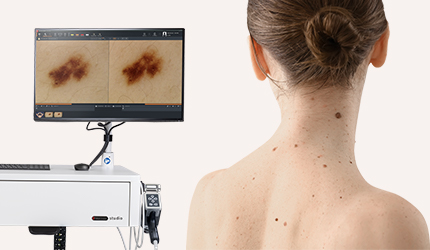
Our clinic is equipped with the Fotofinder ATMB Master, a state-of-the-art device that allows screening for moles and skin cancer for lesions with a diameter greater than or equal to 5 millimeters.

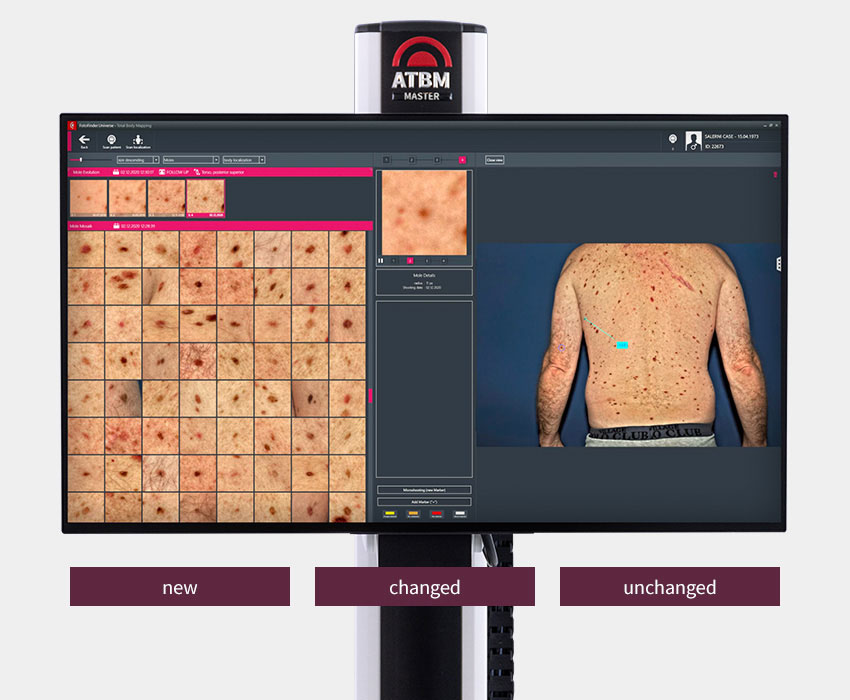
The first step of the examination is an automated full-body photograph (video dermatoscopy) using the FotoFinder, which will serve as a baseline map.
Moles are mapped by the computer and then checked by Dr. Pulcini.
It will also be possible to analyze the evolution of lesions during subsequent examinations.
* Changes in size
* Changes in appearance: color, asymmetry
* Appearance of new lesions
* Disappearance of lesions
* Analysis of moles and skin cancer screening
* Monitoring and follow-up of your lesions year after year
* Assistance with medical and surgical diagnosis
• Analysis of moles and skin cancer screening.
• Monitoring and follow-up of your lesions year after year.
• Assistance with medical and surgical diagnosis.
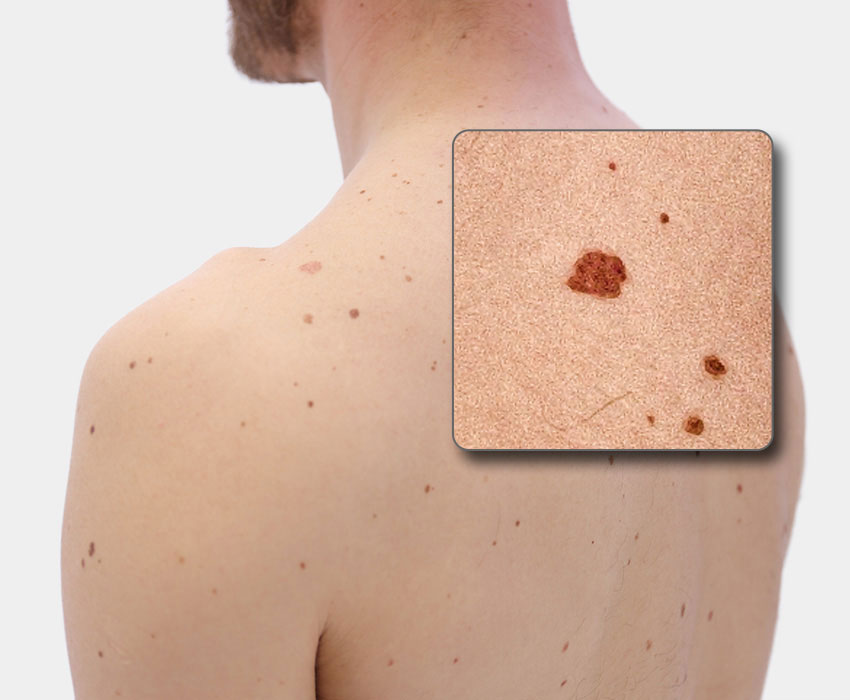
Early detection of skin cancers offers better chances of recovery and survival, particularly in the case of cutaneous melanomas.
Get yourself diagnosed
Early detection of cutaneous melanoma is essential: it offers a better chance of recovery. It consists of regular self-examination of the skin, which allows for the identification of any suspicious lesions.
PERFORMING A SKIN SELF-EXAMINATION
The best way to detect melanoma very early is through skin self-examination.
Skin self-examination is recommended once every three months, especially if you have one or more risk factors for melanoma.
Practice this self-examination regularly, observing all parts of your body, from head to toe. It allows you to spot any suspicious lesions early and to become familiar with your skin, moles, and freckles.
Things to be concerned about:
An old skin lesion that bleeds when touched, grows larger, or changes in size;
a wound that doesn't heal;
a brown spot or pimple that appears on the skin and persists;
a mole that looks different from the others. All of a person's moles look alike.
The one who "is not like the others" should therefore attract your attention. This is the principle of the "ugly duckling";
A mole that changes in appearance rapidly (in shape, size, color or thickness).
Use the ABCDE criteria.
The " ABCDE " can help you recognize warning signs:
A for Asymmetry: the mole is not regular, round, or oval, and its raised areas are not evenly distributed around its center;
B for Irregular Borders: its borders are irregular and poorly defined;
C for Color: it has several colors (black, blue, brown, red, or white);
D for Diameter: it is large (more than 6 mm);
E for Evolution: it changes and grows, changes in thickness and color.
The presence of one or more of these signs does not necessarily mean you have melanoma, but it warrants seeking medical advice without delay.

| Cookie | Duration | Description |
|---|---|---|
| cookielawinfo-checkbox-analytics | 11 months | This cookie is set by GDPR Cookie Consent plugin. The cookie is used to store the user consent for the cookies in the category "Analytics". |
| cookielawinfo-checkbox-functional | 11 months | The cookie is set by GDPR cookie consent to record the user consent for the cookies in the category "Functional". |
| cookielawinfo-checkbox-necessary | 11 months | This cookie is set by GDPR Cookie Consent plugin. The cookies are used to store the user consent for the cookies in the category “Necessary”. |
| cookielawinfo-checkbox-others | 11 months | This cookie is set by GDPR Cookie Consent plugin. The cookie is used to store the user consent for the cookies in the category "Other. |
| cookielawinfo-checkbox-performance | 11 months | This cookie is set by GDPR Cookie Consent plugin. The cookie is used to store the user consent for the cookies in the category "Performance". |
| viewed_cookie_policy | 11 months | The cookie is set by the GDPR Cookie Consent plugin and is used to store whether or not user has consented to the use of cookies. It does not store any personal data. |