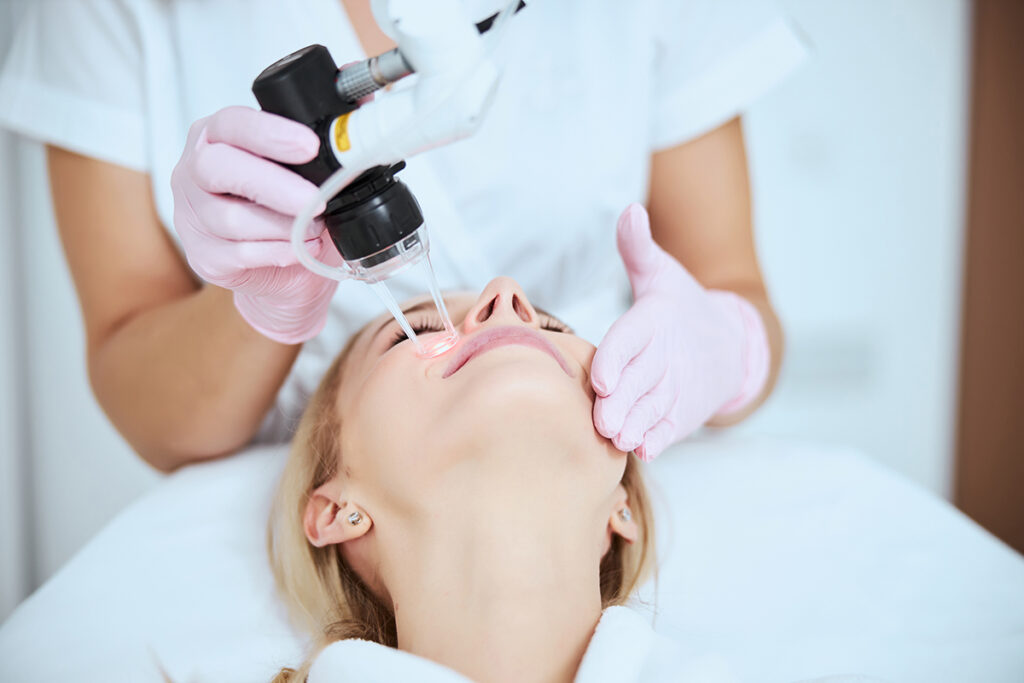
From the English “to peel,” meaning “to peel,” peels involve applying an exfoliating product, which will cause more or less significant peeling of the skin.
Their purpose is to refresh the complexion, remove dark spots, and reduce wrinkles. Peels activate fibroblasts to synthesize new collagen and elastin fibers. The result helps achieve “new skin.”
Why get a facial peel?
The benefits of a facial peel are numerous, but the reasons it is recommended vary. Peels are especially indicated for:
achieving a “radiance boost” effect for a fresher, brighter complexion, treating sallowness and smokers’ complexions, smoothing oily, rough skin with enlarged pores, removing keratoses, seborrheic warts, treating fine lines and superficial or deeper wrinkles, softening wrinkles around the eyes and the area around the mouth (barcode), treating pigmentary disorders: spots, pregnancy mask (Melasma), colored under-eye circles, treating active acne, reducing acne scars. Peels also have a certain tightening effect on skin laxity.
Peels also have a certain tightening effect on skin laxity.
The preferred treatment areas are the face, neck, décolleté, and the back of the hands. The more concentrated a peel is, the stronger the active ingredient it contains, and the more significant its effects will be, with corresponding side effects. The risk of pigment rebound requires precautions regarding sun exposure.
We distinguish 3 types of peels:
Superficial peels A peel based on fruit acids such as Glycolic Acid at 20%, salicylic acid, or pyruvic acid.
A peel based on Trichloroacetic Acid or TCA between 12 and 20% is the most common; it’s a bit the “all-purpose peel.” Usually, no prior skin preparation is needed. Aftercare is simple: rosy skin for a few days, mild peeling, no need to avoid social activities.
No sun exposure for 1 month.
The usual protocol is 3 to 6 peels spaced 15 days apart. Additional maintenance sessions will be scheduled to maintain the results.
Medium peels The TCA acid peel at 20 to 30% is the most commonly used. A skin preparation before the peel and between each session is necessary.
Its penetration power depends on its dwell time and the number of layers applied in each session: the skin becomes white (frosting) on a rosy background.
The aftercare is more significant: brownish desquamation of the skin for one week. Partial social/temporary avoidance is required. No sun exposure for 3 months, SPF 50 protection. The protocol consists of 3 to 6 sessions spaced 3 to 4 weeks apart.
The protocol is 3 to 6 sessions spaced 3 to 4 weeks apart. Maintenance sessions may be scheduled later every 3 to 6 months.
The protocol consists of 3 to 6 sessions spaced 3 to 4 weeks apart. Maintenance sessions may be scheduled later every 3 to 6 months. Within the same family, superficial or medium depigmenting peels based on kojic, phytic, azelaic acid, etc., are more specifically indicated to reduce pigmentations of all origins. Their action is progressive and requires patience to achieve a satisfactory result.
Deep peels Concentrated TCA acid peels at more than 30% or phenol are indicated for severely damaged, very wrinkled skin or skin with pronounced scars. These peels are reserved for experienced practitioners, particularly for phenol, which has toxicity and therefore requires careful mastery. The aftercare is more intensive and the risk of rebound hyperpigmentation is higher, requiring very strict sun avoidance.
30 min
MEN / WOMEN
Light procedure
€150 to €350
Nous respectons votre vie privee
Nous utilisons des cookies strictement necessaires au fonctionnement du site, ainsi que des cookies optionnels (mesure d'audience et publicite personnalisee) uniquement avec votre consentement.
Personnaliser mes cookies
Vous pouvez accepter ou refuser les cookies non essentiels. Les cookies necessaires restent actifs pour le bon fonctionnement du site.