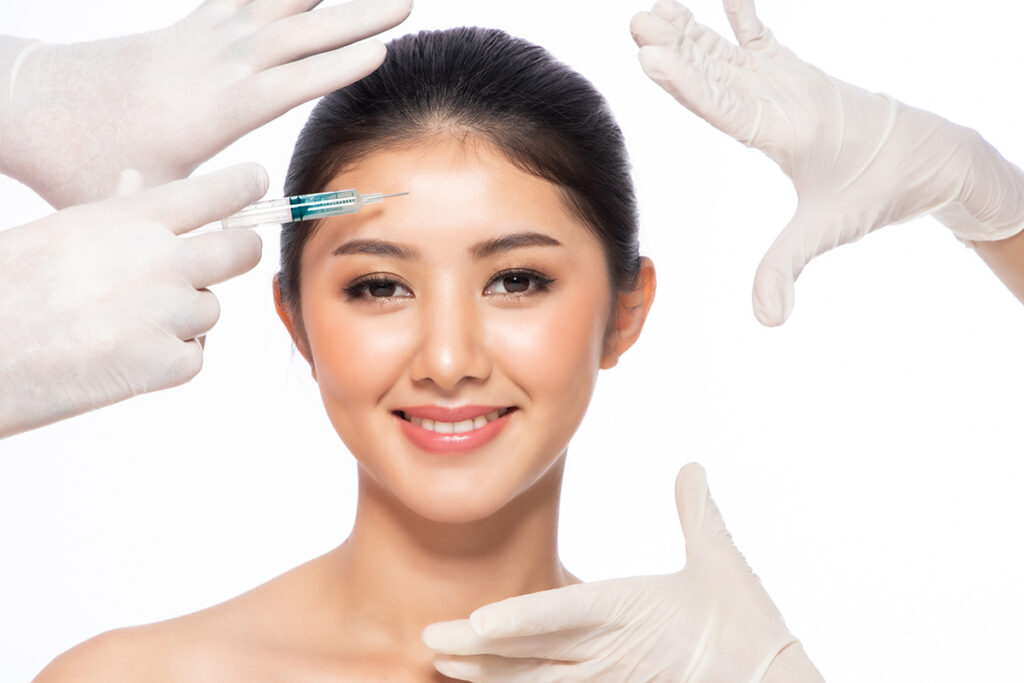
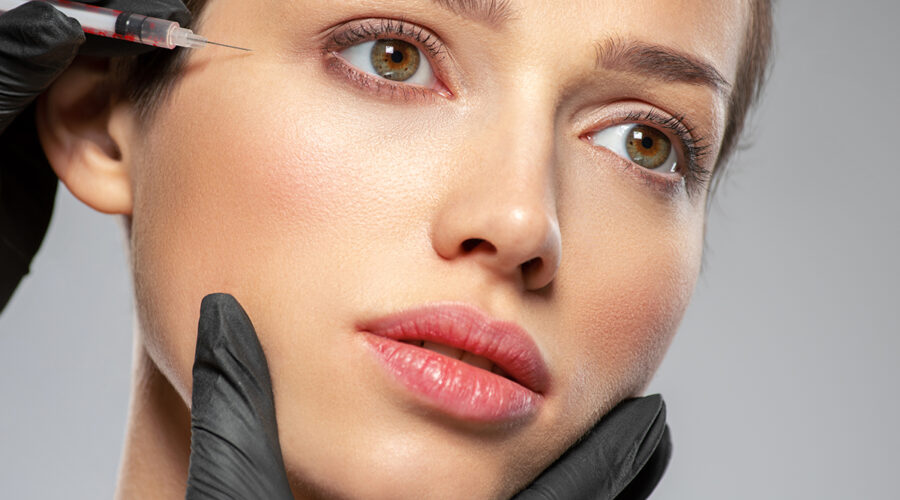
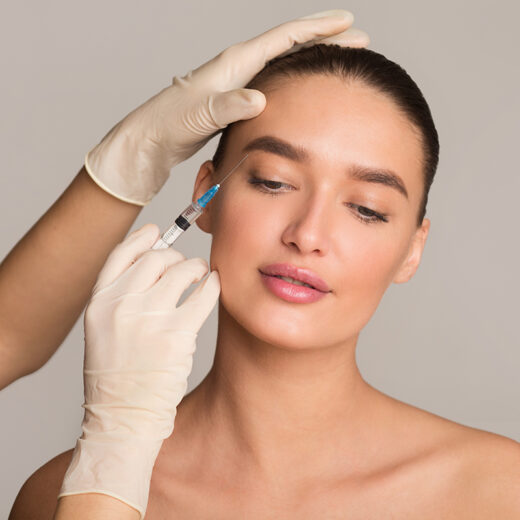
Botulinum toxin is mainly used in aesthetic medicine in young patients (men or women) who have supple, good-quality skin, for prevention or to treat the appearance of the first signs of aging in the upper third of their face.
This injectable product—true stars of aesthetic doctors and surgeons—is also used in older patients with already established wrinkles.
Thanks to this protein complex used since the early 2000s, the natural progression of forming permanent wrinkles is slowed down, and the destruction of collagen appears to be minimized.
Which areas should Botulinum Toxin be injected into?
Botulinum toxin is used to correct many facial imperfections and can be injected into the muscles of the following areas:
Forehead: horizontal or transverse wrinkles in the upper part of the forehead.
Glabella (between the eyebrows): frown lines or glabellar wrinkles (caused by furrowing the eyebrows).
Around the eyes: crow’s feet wrinkles (or wrinkles at the outer corner of the eyes), elevation of the outer tail of the eyebrows, fine lines of the lower eyelids.
Nose: the root of the nose, lateral fine lines.
Cheek: fine lines on the cheeks.
Mouth contour : drooping corners of the mouth, “worry” lines (extending from the lower part of the nostrils to the corners of the mouth), fine lines around the upper lip.
Chin: wrinkles and an “orange-peel” skin appearance.
Neck: neck bands and vertical neck folds (also called platysmal bands).
After an injection of botulinum toxin, the skin naturally becomes smoother and more relaxed. The eyes look less tense and softer; wrinkles are softened and the face looks refreshed—like it has been calmed.
This is a highly effective and safe act of aesthetic medicine to smooth and correct dynamic wrinkles in the upper face.
What are the goals of Botox injections?
Botox (botulinum toxin) injections make it possible to treat: Facial and neck wrinkles. The aftereffects of facial paralysis. Gingival smile. Excessive sweating
Botulinum Toxin as an alternative to aesthetic surgery
Botox injection is a safe and effective treatment: it has established itself as a genuine alternative to plastic surgery procedures such as forehead lifting or injections of permanent products—in order to prevent and reduce signs of facial aging.
To enhance the effects of Botox, it can be combined with other complementary treatments such as hyaluronic acid injections or chemical peeling.
Can a Botox injection be dangerous?
Botox cannot cause serious and irreversible damage. Effects last on average 4 to 6 months and always fade.
The most common side effects are an asymmetry of results or a temporary drooping (ptosis) of the eyebrows that disappears within a few days.
Botox for a natural result
Botox injection is a safe and effective treatment: it has established itself as a genuine alternative to plastic surgery procedures such as forehead lifting or injections of permanent products—in order to prevent and reduce signs of facial aging.
To enhance the effects of Botox, it is possible to combine them
How does a Botox injection work?
What contraindications are there before a Botulinum Toxin injection?
As a precaution, Botox injections are not carried out if you are pregnant or breastfeeding. During your first information consultation, it is important to tell Dr. Pulcini if you have inflammation of the face or progressive muscular diseases (myasthenia) or neurodegenerative diseases, if you have had an eye (corneal) operation recently, or if you are taking medication (anticoagulants).
The safety of botulinum toxin has been proven for several decades: this injectable product carries absolutely no risk of toxicity at the doses used in aesthetics. Botox also poses no risk of allergy, nor any long-term aftereffects.
What precautions should you follow after an injection?
It is not recommended to lie down, to do intense physical activity, to go to the Spa (hamman or sauna), or to massage the injected areas during the 48 hours following a botulinum toxin injection.
It’s best to avoid taking aspirin or anti-inflammatory medications until the day after the treatment. Wearing a bicycle or motorcycle helmet, as well as hair scarves and caps, is also not recommended throughout the half-day following the aesthetic procedure.
Side effects are extremely rare. You may notice a slight redness or even a small edema for a few minutes, or feel a sensation of tightness in the forehead. These temporary effects can occur at the injection sites and disappear quickly, within the minutes or hours following the injection.
Results after a Botox injection
Results are visible 7–10 days after the injection depending on the toxin, and are optimal about 3 to 4 weeks after the session.
You’ll observe a reduction in expression lines caused by muscle contraction: the frown lines are visibly softened, the forehead skin appears smoothed and relaxed, your face looks younger, and your gaze looks refreshed. A free follow-up consultation allows the result to be checked and, if necessary, for a slight touch-up to optimize future sessions.
Botulinum toxin poses no risk to the patient. It has been used since 1975 in neurology, ophthalmology, and pediatrics to correct facial tics and spasms, involuntary eye blinking, and childhood strabismus.
Price of a Botox injection
From €350
20–30 minutes
MEN / WOMEN
Light touch
390€
Nous respectons votre vie privee
Nous utilisons des cookies strictement necessaires au fonctionnement du site, ainsi que des cookies optionnels (mesure d'audience et publicite personnalisee) uniquement avec votre consentement.
Personnaliser mes cookies
Vous pouvez accepter ou refuser les cookies non essentiels. Les cookies necessaires restent actifs pour le bon fonctionnement du site.