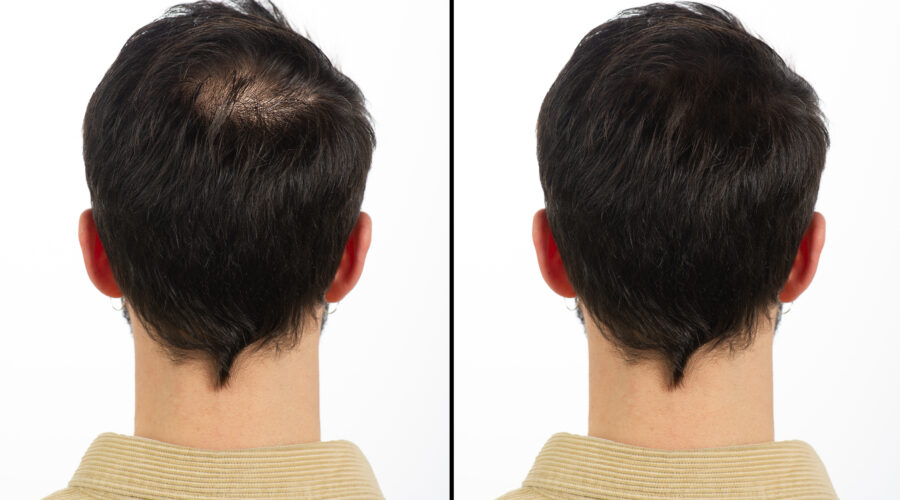
Hair grafts are the only treatment that makes it possible to definitively treat an area of alopecia.
Androgenetic alopecia affects up to 50% of men and women throughout their lives.
Only surgery can permanently, definitively treat an area of alopecia.
Today, the surgical management of alopecias, in particular androgenetic alopecia (AGA), is primarily based on autograft techniques, namely FUE (Follicular Unit Extraction), Follicular Unit Hair Transplantation (FUT), and FUL (follicular unit long hair).
strip Baldness (male and female) is due to the sensitivity of hair follicles (which give rise to the hair) to a hormone: dihydrotestosterone (DHT), a derivative of testosterone.
It is exposure of the follicles to DHT that prevents their regeneration, which is why they ultimately fall out. Not all follicles are sensitive to these hormones. The hair of the “crown” (the outline of the head) is not sensitive to DHT and therefore does not shed, even with age.
So the principle of hair transplantation is to implant these crown hairs—insensitive to DHT—into the balding area. Once the graft has taken, these DHT-insensitive hairs will no longer fall out due to androgenetic alopecia.
There is no rejection because it is an autograft.
The course of the procedure
FUE
First step: extraction of follicular units
After prior local anesthesia, extraction of the follicular units is carried out in the donor area; each unit contains 1 to 4 hairs.The extraction is performed using a “micro-punch” with a diameter of less than 1 mm, which leaves no scar.
Second step: implantation of hair grafts via micro incisions.Advantages of FUE micro hair grafts: a non-invasive micro surgery No scars in the donor area, No bleeding, No pain, No edema,
No damage to the hair implant (very low transection rate), 1 to 3 days
Natural-looking results Higher density Possibility to correct the beard as well as scars in these areas (upper lip, chin, etc.) and in the eyebrows.
Strip
The procedure involves removing a strip of scalp skin from the occipital area, then, under a microscope, extracting the follicular units.Next, the donor area is closed using the trichophytic technique (NATAF) so that the hair grows back through the scar and camouflages it.
The implantation is performed in the same way as for FUE. The operative time is shorter, but there is a scar in the occipital area.
Follow-up and results
The results are very natural; the assessment done at a distance will make it possible to evaluate whether additional sessions may be needed depending on the density achieved and each patient’s wishes.
Definitive results are assessed at one year.
Complementary treatments
Medical treatments
The minoxidil lotion ® (the only topical treatment) and finasteride ® (oral treatment) are not 100% effective; in general, they stop hair loss, but in no case do they restore lost hair. Their effect fades after about 24 months.
In addition, when treatment is stopped, any gains obtained are quickly lost.
It is recommended to combine a treatment—generally minoxidil before and after the grafts. Applying it twice a day helps slow down hair loss by acting on local vascularization. This improves the recipient site for the grafts.
Outpatient surgery: enter in the morning and leave the same day. A consultation is carried out at 48 hours and at 10 days post-operatively. It is a minimally painful surgery; Doliprane medication is sufficient. In the case of FUE: simple sensitivity in the donor and recipient areas.
And in the case of FUT: occipital tension due to the harvesting of the strip.
The grafting is done over 2–3 days and gentle shampooing is then possible. Social downtime varies and may range from 1 to 7 days depending on the technique used and its extent.
There are few complications to note: Bleeding may be observed from one of the donor or graft points, requiring only simple compression. Superinfection is very rare and, in general, localized.
5 HOURS
MEN / WOMEN
Intermediate procedure
3700€
Nous respectons votre vie privee
Nous utilisons des cookies strictement necessaires au fonctionnement du site, ainsi que des cookies optionnels (mesure d'audience et publicite personnalisee) uniquement avec votre consentement.
Personnaliser mes cookies
Vous pouvez accepter ou refuser les cookies non essentiels. Les cookies necessaires restent actifs pour le bon fonctionnement du site.