Tattoo inks are pigment inclusions in the dermis or the hypodermis
The principle of the lasers currently used for tattoo removal is the fragmentation of the pigment.
The appearance of Q-switched lasers revolutionized the tattoo erasing process, which in many cases can be removed with almost no trace.
This type of laser is the only way to properly erase tattoos while avoiding scars, which are common with other strategies such as CO2, dermabrasion, or acid tattoo removal. It uses an innovative photoacoustic technology that produces powerful energy through narrower pulses.
TREATMENT INDICATIONS
The QUANTA Q Switched laser makes it possible to remove all types of professional and amateur tattoos. Small ornamental black, blue, or red tattoos respond well to the laser and can often be erased quickly. Orange and violet inks can also be treated with very good results, thanks to the use of a specific crystal for these color types. Turquoise and green are the colors that resist the most. Cosmetic tattoos used as permanent makeup can also be removed.
PROTOCOL
PRELIMINARY CONSULTATION
The preliminary consultation not only makes it possible to prepare an estimate but also to prescribe a care protocol that optimizes the course of treatment and its short- and medium-term aftereffects.
COURSE OF THE SESSION
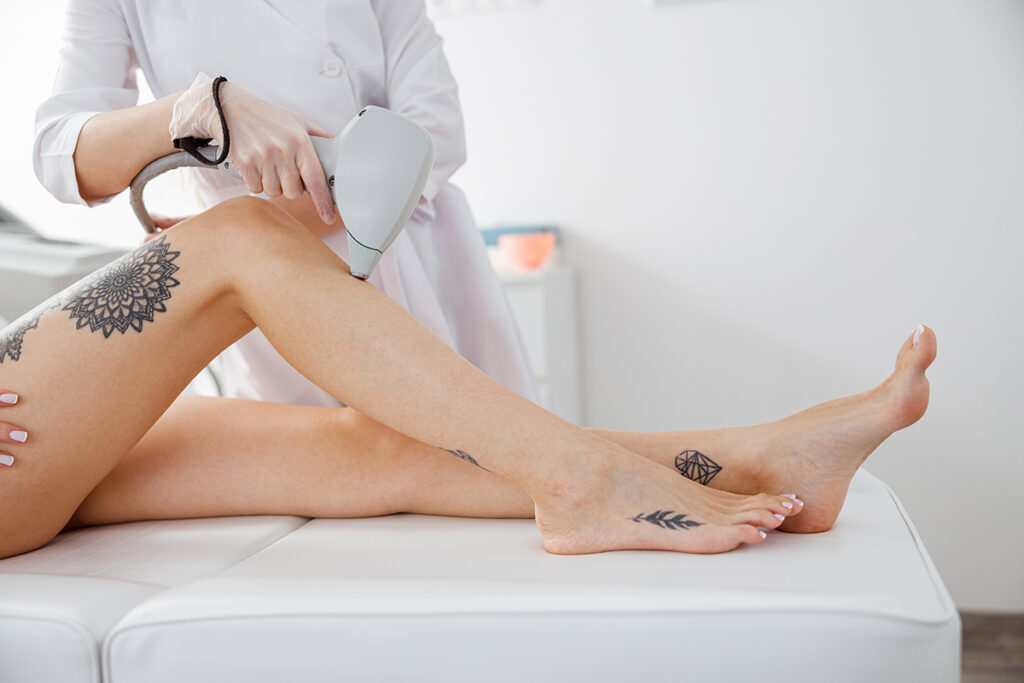
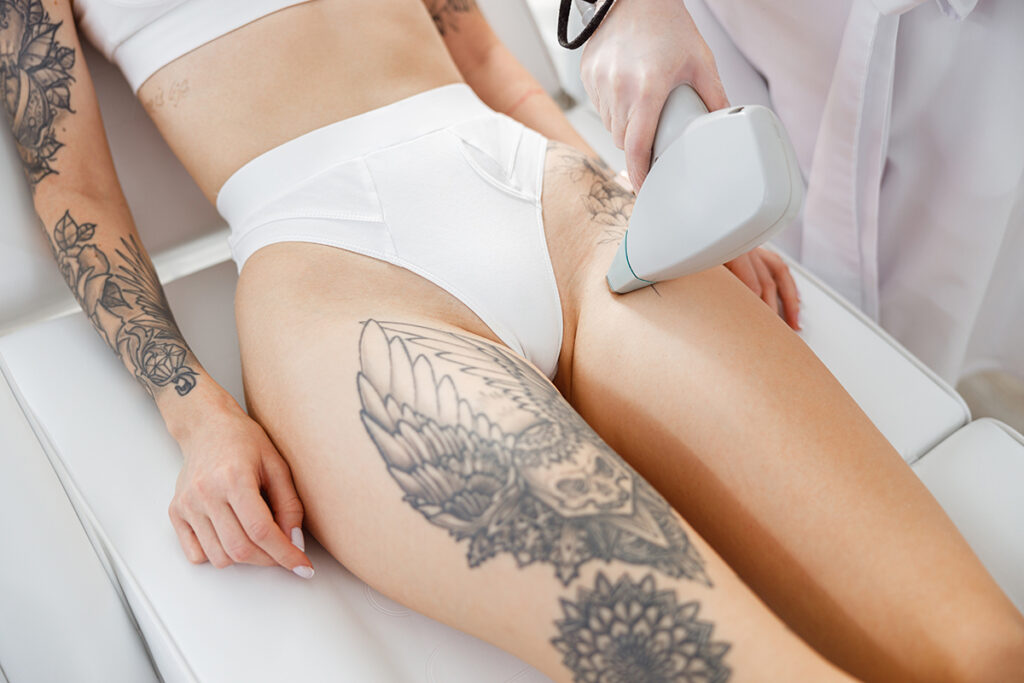
During treatment, brief, focused light pulses are directed at the tattoo. The light wavelengths and energy heat the tattoo and fragment the ink molecules. Fragmentation of the mineral particles leads to their elimination trans-epidermally on the one hand, and to their phagocytosis by macrophages on the other. The tattoo fades as the immune system eliminates the scattered ink particles. Quanta System’s Q-PLUS laser is the only Q-switched laser that can be configured with Ruby and Nd:YAG laser sources. It thus uses wavelengths of 532, 694, 1064nm, which makes it possible to effectively eliminate all tattoo colors—mainly black, blue, purple, yellow, green, and red pigments—with a very low risk of scarring or changes in the skin’s texture.
The session takes place under local anesthesia. Treatment is progressive. Several spaced-out sessions are required. For complete treatment, 6 to 8 sessions are needed, with an interval of one month.
Treatment of black or blue tattoos requires, depending on their size and depth, 3 to 10 treatment sessions.
The presence of multiple colors may require additional sessions.
AFTERCARE
After tattoo removal, the procedure includes a weeping phase in the treated area.
It is important for the patient to use dressings containing a local antibiotic during the first week, and then dressings containing a healing agent during the following two weeks.
A follow-up is essential after one month, if needed during the next session of the care program.